

Why Customer and Partner Advisory Boards Are Essential to Strategy and Competitive Differentiation
One of the most common challenges I see when working with leadership teams is not a lack of strategy. It is a lack of external perspective shaping that strategy.
Organizations invest a tremendous amount of time and energy building plans internally. Leadership teams analyze data, evaluate markets, and debate priorities with discipline and good intent. But too often, those strategies are shaped primarily through an internal lens and only tested against the market after execution is already underway.
In today’s environment, that is a risky approach.
By Gordon Galzerano, CEO & Managing Partner, Timberwilde Consulting Group
One of the most common challenges I see when working with leadership teams is not a lack of strategy. It is a lack of external perspective shaping that strategy.
Organizations invest a tremendous amount of time and energy building plans internally. Leadership teams analyze data, evaluate markets, and debate priorities with discipline and good intent. But too often, those strategies are shaped primarily through an internal lens and only tested against the market after execution is already underway.
In today’s environment, that is a risky approach.
Markets are moving faster than ever. Customer expectations are constantly evolving. New competitors are entering without the burden of legacy models. Under those conditions, designing strategy in isolation is no longer sustainable.
This is where Customer and Partner Advisory Boards become so important.
The most effective organizations are not treating advisory boards as marketing programs or relationship events. They are using them as structured leadership mechanisms that bring the voice of customers and partners directly into how decisions are made.
That distinction matters.
A lot of companies believe they are listening to their customers because they run surveys, monitor satisfaction scores, or conduct quarterly business reviews. Those inputs have value, but they are inherently backward-looking. They tell you what has already happened.
Advisory boards, when done well, do something very different.
They create an environment where senior leaders can engage directly with customers and partners in a more open, forward-looking dialogue. The conversation shifts away from performance reviews and toward what the future should look like.
In those discussions, you start to hear things that rarely surface through traditional channels. You gain perspective on where the industry is heading, how priorities are shifting, where customers are feeling pressure, and what risks may be emerging before they are visible internally.
The quality of insight is simply different when it comes from peer-level conversations.
The importance of advisory boards has grown significantly, and there are a few reasons why that keeps showing up in my work.
First, strategy can no longer be something that is defined once a year and revisited twelve months later. The pace of change has made that model outdated. Leadership teams need a way to continuously test and refine their thinking based on what is happening in the market in real time. Advisory boards create that ongoing feedback loop.
Second, expectations from customers and partners have changed. The most strategic relationships are no longer satisfied with being managed. They want to have a voice in shaping direction. When you bring them into an advisory setting, it signals that their perspective matters and that the relationship goes beyond transactions. It changes the dynamic in a meaningful way.
Third, insight itself has become a competitive advantage. Products can be replicated. Pricing can be matched. Even technology advantages tend to narrow over time. What is much harder to replicate is a deep understanding of where your customers and your ecosystem are going next.
Organizations that build that level of insight into how they operate tend to make better decisions, and they make them earlier.
When leadership teams engage meaningfully with Customer Advisory Boards, a few things start to happen.
Strategy becomes more grounded. Assumptions get tested before significant investments are made. Innovation improves because customers help define the problems that actually need to be solved. And relationships deepen in a way that is difficult to achieve through traditional account management alone.
Just as importantly, the voice of the customer starts to show up where it matters most, in the executive conversations where strategic decisions are made.
Partner Advisory Boards bring a different, but equally valuable, perspective.
Customers give you depth within their own experience. Partners, on the other hand, see across multiple organizations, markets, and competitors. They often recognize patterns earlier because of that broader exposure.
When leadership teams engage their partners in a structured way, they gain a clearer view into how go-to-market models are evolving, where friction exists, how competitive dynamics are shifting, and where there may be opportunities to innovate together.
Listening to partners does more than strengthen those relationships. It sharpens how the organization shows up in the market overall.
One of the distinctions I pay close attention to is whether a company is simply holding advisory meetings or whether it has built a true advisory mechanism.
There is a difference.
Participants can tell very quickly if their input is influencing real decisions. When they see that connection, engagement deepens. When they do not, advisory boards tend to become more symbolic than impactful.
Leadership credibility is built on what happens after those conversations.
I often describe advisory boards as a way to close the gap between internal intention and external reality.
They give leadership teams a chance to pressure-test strategy before the market does it for them. They surface risks earlier, clarify opportunities more quickly, and create stronger alignment between the organization and the ecosystem it serves.
Simply put, they make strategy better.
At Timberwilde Consulting Group, we see Customer and Partner Advisory Boards as a foundational element of modern leadership. When they are integrated with Strategic Account Management and consistent executive engagement, they create a continuous cycle of insight, alignment, and innovation.
The organizations that outperform are not just talking about being customer-centric. They are building their strategies with direct input from the people who experience their business every day.
That is where differentiation is increasingly coming from.
The leaders who get this right understand something simple but powerful. Strategy is always stronger when it is shaped with customers and partners, not presented to them after the fact.
Strategic Account Management Requires Leadership: Why C-Suite Sponsorship Determines Success
Over the past several years, I’ve worked with organizations across a range of industries that are making meaningful investments in Strategic Account Management as a growth strategy. The rationale is clear to most leadership teams. A relatively small group of customers often represents a disproportionate share of revenue, innovation potential, and long-term enterprise value.
And yet, I continue to see the same pattern play out.

By Gordon Galzerano CEO & Managing Partner, Timberwilde Consulting Group
Over the past several years, I’ve worked with organizations across a range of industries that are making meaningful investments in Strategic Account Management as a growth strategy. The rationale is clear to most leadership teams. A relatively small group of customers often represents a disproportionate share of revenue, innovation potential, and long-term enterprise value.
And yet, I continue to see the same pattern play out.
Organizations launch Strategic Account Management programs with the right intent. They put strong account leaders in place. They build thoughtful processes. On the surface, everything looks positioned for success. But many of these efforts fall short of delivering the kind of transformational outcomes leadership is expecting.
What’s interesting is that the issue is rarely execution at the account level.
More often, the gap comes down to something much simpler and much more difficult to address. There is not consistent, visible, and sustained sponsorship from the C-suite.
At its core, Strategic Account Management is a leadership issue.
One of the most common misconceptions I encounter is that Strategic Account Management sits within sales. That framing makes sense on the surface, but it misses the bigger point.
SAM fundamentally changes how an organization prioritizes customers, how it allocates resources, and how it aligns internally. Strategic customers influence far more than revenue. They shape product direction, service delivery, innovation priorities, and even how the market perceives your organization.
Managing relationships at that level requires coordination across the enterprise. That is not something a sales team can drive on its own.
When SAM is treated as a sales initiative, it inevitably competes for time, attention, and resources. When it is owned and led by the C-suite, it becomes part of the company’s business strategy.
And that distinction changes everything.
Organizations take their cues from leadership. What leaders prioritize, the organization prioritizes. What leaders engage in, the organization pays attention to.
If Strategic Account Management is positioned as important but leadership engagement is limited, it quickly becomes just another responsibility layered onto already full roles.
I often say that people do not follow initiatives. They follow leadership behavior.
When executives are visibly engaged, it sends a very different message. That engagement shows up in simple but meaningful ways. Leaders are present in strategic account reviews. They build direct relationships with senior stakeholders on the customer side. They consistently reinforce the importance of strategic accounts in how they communicate across the organization. They align incentives in a way that reflects long-term customer value, not just short-term performance.
Those actions move SAM from concept to reality.
Another challenge that shows up consistently is internal friction. From the customer’s perspective, they expect to experience your organization as one cohesive partner. Internally, most companies are still operating across functions that were never designed to move in sync.
Account teams feel this every day. They are navigating competing priorities across operations, finance, product, and commercial teams, often without the authority to resolve those conflicts.
This is where executive sponsorship becomes critical.
Leadership has the ability to align priorities and remove barriers in a way that no individual team can. In the organizations that do this well, collaboration is not just encouraged. It is actively governed.
There is also a piece of Strategic Account Management that is often underutilized, and that is executive-to-executive engagement with customers.
When senior leaders on both sides of the relationship are connected, the conversation changes. It moves beyond transactions and into areas like shared strategy, risk, innovation, and long-term growth.
Those relationships build trust faster. They create earlier visibility into change. And they position your organization as a true partner rather than a supplier.
In many cases, this is where the greatest untapped value exists.
Strategic Account Management also forces a different set of decisions than most organizations are used to making.
It requires being intentional about where you invest and recognizing that not all customers should be treated the same. It requires balancing short-term revenue with long-term value creation. It requires leadership to spend time differently and, in some cases, to support solutions that do not fit neatly into standardized offerings.
These are not decisions that can be pushed down into the organization. They require leadership ownership.
Without that, most organizations default back to treating customers equally, even when they know that not all relationships carry the same strategic importance.
I have also seen a clear difference between organizations that launch SAM programs and those that truly embed them.
Launching a program is relatively straightforward. Embedding it as a lasting capability is something else entirely.
The difference comes down to how leadership shows up over time.
The most effective C-suite sponsors tend to play three roles, whether they describe them this way or not. They consistently articulate why strategic customers matter to the future of the business. They align the organization around that belief by shaping governance, incentives, and structure. And they stay personally engaged, both with customers and with internal teams, to ensure accountability.
When those elements are in place, Strategic Account Management becomes part of how the organization operates. It stops feeling like an initiative and starts functioning as a core capability.
At the end of the day, this is a leadership choice.
Organizations have to decide whether strategic customers will be managed operationally or led strategically.
The companies that are getting this right are leaning into a different model of growth. One that is built on deeper partnerships, co-innovation, and long-term value creation with a focused set of customers.
That shift is not something you can delegate.
It has to be led.
Agility Is the New Competitive Advantage, and Most Organizations Are Behind
For decades, companies competed on scale, efficiency, and execution. Those advantages still matter, but they are no longer enough.
What I see today is not organizations losing because they cannot execute. They are losing because they are moving at yesterday’s speed in a market that no longer operates in predictable cycles.
Disruption is no longer an isolated event. It has become a constant condition of the modern marketplace.
And one of the more uncomfortable truths I share with executive teams is this. Most organizations are not being disrupted by a specific competitor. They are being disrupted by the pace of change itself.
By Gordon Galzerano, CEO & Managing Partner, Timberwilde Consulting Group
For decades, companies competed on scale, efficiency, and execution. Those advantages still matter, but they are no longer enough.
What I see today is not organizations losing because they cannot execute. They are losing because they are moving at yesterday’s speed in a market that no longer operates in predictable cycles.
Disruption is no longer an isolated event. It has become a constant condition of the modern marketplace.
And one of the more uncomfortable truths I share with executive teams is this. Most organizations are not being disrupted by a specific competitor. They are being disrupted by the pace of change itself.
Across industries, I consistently see three forces reshaping what it takes to remain competitive. Customers are evolving faster than organizations can respond. Technology is redefining how value is created at a pace most leadership teams struggle to keep up with. And new entrants are not trying to fit into existing models, they are bypassing them altogether.
These are not short-term trends. This is a permanent shift in how markets operate.
The first shift is happening with customers.
Customers today are not comparing you to your direct competitors. They are comparing you to the best experience they have had anywhere. That one reality has fundamentally reset expectations.
A seamless consumer app now influences what someone expects from enterprise software. Real-time tracking in logistics shapes expectations in healthcare. Personalization is no longer impressive, it is assumed.
What customers want is increasingly clear. They expect organizations to anticipate needs before they are even articulated. They expect interactions to feel seamless and relevant. They expect transparency in real time. And more than anything, they expect you to show up as a partner, not just a vendor.
At the same time, many organizations are still anchored in annual planning cycles, siloed decision making, and priorities that are driven internally rather than externally.
This creates what I often describe as the relevance gap. It is the distance between how quickly customers are evolving and how quickly an organization is able to change. Once that gap widens too far, it becomes very difficult to close.
The organizations pulling ahead are not guessing what customers might want next. They are in a constant state of learning from their customers and evolving alongside them.
The second shift is around technology.
There is still a tendency in many leadership conversations to position technology as something that supports the business. That mindset no longer holds.
Technology is the business strategy.
Artificial intelligence, automation, data ecosystems, and digital platforms are not just improving operations. They are fundamentally changing how value is created, how it is delivered, and how it is experienced.
The real disruption is not the existence of these technologies. It is the different ways competitors are using them.
I see three things happening as a result. First, the speed of insight has become a differentiator. Data is everywhere, but advantage goes to those who can act on it faster than others. Second, business models are being reinvented. Subscription models, platforms, and outcome-based approaches are replacing traditional transactional relationships. Third, organizations now have a level of visibility into customer behavior that did not exist before, and customers expect that visibility to translate into better, more relevant experiences.
The biggest risk is not failing to adopt new tools. It is adopting them while holding onto outdated ways of thinking.
The third shift is being driven by new entrants.
Historically, new competitors tried to incrementally outperform incumbents. That is no longer the case.
Today’s disruptors are not playing by the existing rules. They are redesigning the game entirely.
They are not burdened by legacy infrastructure or internal silos. They are not protecting historical incentives or legacy revenue streams. Instead, they start with a much simpler question. If we were to build this industry today, how would it work?
More often than not, customers prefer the answer they come up with.
You can see this playing out across industries. Financial services, healthcare, logistics, and others are all being reshaped by organizations that prioritize simplicity, speed, and alignment with modern expectations.
Incumbents tend to optimize what already exists. New entrants reimagine what is possible. And increasingly, reimagination wins.
What makes this particularly challenging is how these forces interact with each other.
Customers are demanding faster evolution. Technology is accelerating the ability to innovate. New entrants are leveraging both at the same time.
The result is that time itself is being compressed. Strategic timelines that used to span years are now measured in quarters.
This is why agility has become such a critical leadership capability.
I am not talking about agility as constant change or organizational chaos. I am talking about structured adaptability. The ability to make decisions faster and closer to the customer. The ability to align teams around outcomes instead of functions. The discipline to continuously bring external insight into strategy. And the willingness to challenge long-held internal assumptions.
Agility is not an initiative. It is a mindset that starts at the executive level.
When I sit down with CEOs and leadership teams, I often ask a simple question. Are you transforming at the pace of your market, or at the pace of your organization?
Those two speeds are rarely the same.
The organizations that are pulling ahead are not waiting for disruption to become obvious. They are deeply engaged with their customers. They are building partnerships across their ecosystems. They are embedding external perspectives into how they think about strategy. And they are creating cultures that are comfortable evolving.
At Timberwilde Consulting Group, we see this consistently. Organizations that invest in customer engagement, Strategic Account Management, and meaningful executive collaboration with stakeholders effectively build an early warning system for change.
They do not react to disruption. They see it coming and move ahead of it.
Which brings us to what competitive advantage really means today.
It used to be about scale, efficiency, or intellectual property. Those things still matter, but they are no longer sufficient on their own.
Today, competitive advantage comes down to something much more straightforward, and much more difficult to achieve. It is the ability to adapt faster than your competitors while staying aligned with your customers.
The organizations that will thrive over the next decade will not be the ones that resist change or try to outlast it. They will be the ones that continuously reinvent themselves in step with the markets they serve.
Because in this environment, agility is not optional.
It is the price of staying relevant.
Events & Keynote Speaking
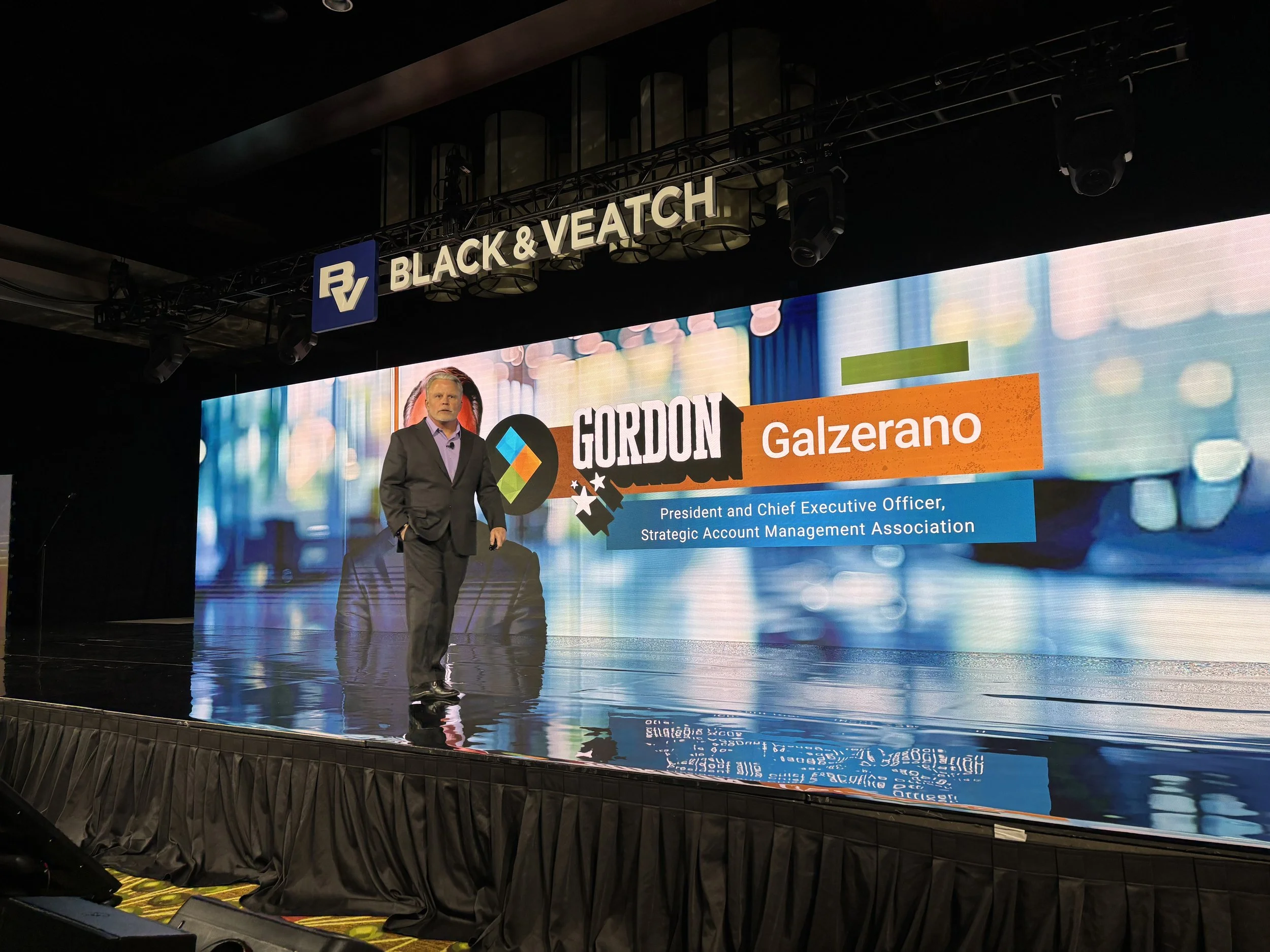
As CEO and Managing Partner of Timberwilde Consulting Group, Gordon Galzerano delivers compelling, insight-driven keynote presentations designed to help executive leaders navigate disruption, accelerate growth, and reposition their organizations for the future.
-
Vision Summit
10.21 7:00-8:00PM
An interactive session for makers and thinkers to collaborate, connect, and spark new ideas.
-
Creative Sync
10.21 7:00-8:00PM
An interactive session for makers and thinkers to collaborate, connect, and spark new ideas.
-
Inspire Night
10.21 7:00-8:00PM
An interactive session for makers and thinkers to collaborate, connect, and spark new ideas.